

Note to reader: This lesson is usually taught in mid February. Currently I am posting writings from my graduate program in preparation for a speech in November.
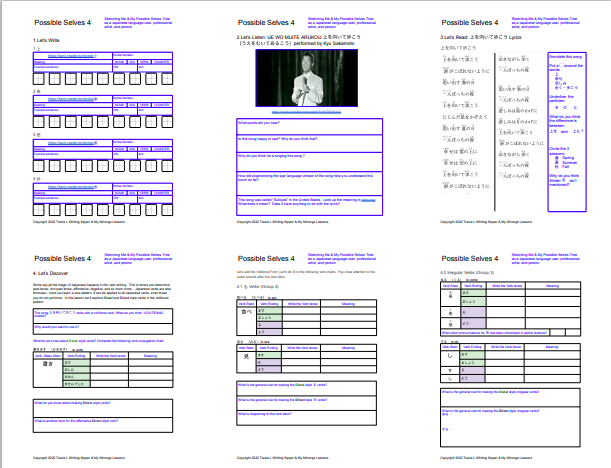
This is UNIT 4 in the Possible Selves program: Sketching me and my possible selves tree as a Japanese language user, professional, and person. Today’s post features the worksheets for the Japanese language focusing on verb conjugations while learning about Kyu Sakamoto’s influence on the Japanese psyche of perseverance. Some activities may be just beyond what you or your students are able to process, but give it a try. You may be surprised at what you can do.
You can find links to the other units here: Possible Selves as a Japanese Language User
Kyu Sakamoto – Let’s walk looking up
坂本九 ー 上を向いて歩こう

Step 1: Learn 4 new kanji (上 幸 悲 歩)
Step 2: Listen to the song: 上を向いて歩こう
- Listen and then record your observations
Step 3: Annotate the lyrics to 上を向いて歩こう
- Novice: new learners may only be able to identify the 4 new kanji and the katakana. Encourage them to notice the differences between the 3 scripts, and how we can distinguish the different words and particles. Point out the use of furigana.
- Intermediate: after annotating the lyrics, use a Japanese-English dictionary such as jisho.org to find the meaning of the verbs. Remind them that most action verbs come after を. Point out the the four seasons kanji in the side bar and locate 3 in the lyrics. Why might winter be missing?
Step 4 Let’s Discover: 上を向いて歩こう
- For all learners, they will learn how to conjugate distal style verbs into the volitional style to imply “Let’s X” This is a good time to review the basic distal verb conjugations.
- For intermediate and experienced learners, explore how to create the volitional style from the direct/dictionary form of verbs.
Step 5 Let’s Express Our Hopes: Class compilation
- For all learners: If students are unfamiliar with the Tohoku disaster of March 11, 2011, this is a compilation of personal videos from various parts of the region at the moment of the disaster. It is almost 27 minutes long. If could be assigned as homework or parts selected to show in class. The class may be more solem after the video and in the right frame of mind for the next step. Teachers of young students should edit accordingly. https://www.youtube.com/watch?v=OvG8LGKyC24
- Following the Tohoku disaster in 2011, Suntory Beverage & Food company brought together over 70 artists to compile 30- and 60- second messages for the Great East Japan Earthquake Recovery Effort.
- Record observations on the worksheet. https://www.youtube.com/watch?v=p8ZA3IvZnCo
- Watch this version by various artists in response to quarantine in Japan due to Covid-19.
- Record observations on the worksheet
- Discuss with students how the same song can give hope in difficult times. It is a song of positivity even in the face of disaster and world pandemic.
- Students will create a compilation version of 上を向いて歩こう similar to the video above where the singers hold up messages of encouragement (make sure you watch that part of the video!)
Karaoke version: https://www.youtube.com/watch?v=xQAZsnLC28w
Live with Kyu Sakamoto; https://www.youtube.com/watch?v=N4hh28_hdD8. - If you attempt this video compilation, please post to youtube with the hashtags #possibleselves #Uewomuitearukou #mynihongolessons
Even if the projects are challenging, your students may be up to it. These lessons are a bit out of the box and use authentic videos. It is very exciting for students to start hearing and understanding things designed for native speakers.
Click here for the Thinking about the Japanese language worksheets
Tomorrow I will post the Creating section of this unit where students use their new knowledge of the Tohoku disaster and Ue wo muite arukou to research with authentic materials about Miharu Takizakura (三春滝桜) in order to create a cultural artifact aligned with Step 4 of Possible Selves.
Let me know what you think of these multiliteracy activities in the comments section.


Leave a Reply