

How do you stay motivated to keep learning and using Japanese? From my studies and experiences I believe that developing learner motivation is important in the early stages. For more commonly taught languages in the US there are often many opportunities to experience using the language. The linguistic distance of most European languages from English are close enough that a few years of study are sufficient for proficiency. According to the Foreign Service Institute, Japanese is considered a category IV language. Of the languages in this category (Arabic, Cantonese, Mandarin, Korean, and Japanese), Japanese is considered most difficult.
(Self study learners, if you are easily discouraged, scroll down to the good stuff in the next section)
Let’s break that down….
For a student of Japanese to become proficient they will need at least 88 weeks of instruction or 2200 hours of class time.
Let’s consider the possiblitiy of learning Japanese only in a college classroom and never going abroad.
Most college semesters are 16 weeks, but to be honest, nothing new is usually learned the first and last weeks of a semester, and if the campus has a ‘dead week” the week before finals, there is a third week without learning… so let’s consider a 14 week semester. A college student needs to take just over 6 semesters of Japanese to become proficient if they were studying only Japanese full time. I don’t know of anyone who has done that without going abroad. In my opinion and experience I don’t think a regular full-time student who never does an exchange and who is taking the usual general education requirements and courses for their major (even if it is Japanese) can expect to have a high degree of proficiency after 4 years of college education.
Let’s consider the number of hours needed for proficiency: 2200.
For a 5 credit course (5 hrs x 14 learning weeks in a semester) there are 70 class time hours. If our regular student does not go abroad and only studies Japanese during class time, they will need almost 31.5 semesters of Japanese. That’s 15 years…. 10 if they include summer semester. (2200 hours/ 70 hour semester) For a 3 credit course (3 hrs x 14 learning weeks in a semester) there are 42 hours of class time. If they never go abroad and only experience Japanese during class they will need almost 53 semesters or 26 years…17 if they take summer classes.
For my students at the art college, I only have them at most for 4 semesters, but often only for 2 due to graduation requirements. (Art school is tough!). If they can go abroad it is only for a semester and unfortunately the school we have a relationship with has a unreasonably high proficiency requirement that my students do not have time to achieve. My students cannot enroll in my Japanese language courses until their sophomore year. This means they have only 2 semesters to study if they have not started on their own. It is nearly impossible. How then can I encourage them to develop their proficiency in light of all these obstacles?
How can we encourage our students and those who are doing Japanese by self study methods to keep pushing through when it is tough? How do we keep them motivated?
(Self study learners… keep reading! This applies to you, too!)
For the past few years I have used the Possible Selves method to plant the seed that they will be users of the Japanese language within the next 10 years. Along with an strong multi-literacy approach, reflecting, and project based learning I am seeing their language confidence developing. Language proficiency is a tiny motivational seed that must be planted early.
What is the Possible Selves method?
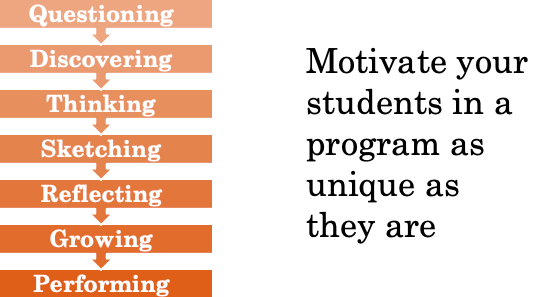
- A 7-unit program that leads students in a discovery of what their career and life paths may look like when they are also foreign language users.
- Supplemental or integrated into your current curriculum and adjusted for age, proficiency, and student demographics.
- Self Study learners can also benefit from this program.

For the program that I developed for use at my school, each unit explores artifacts and authentic documents to support both cultural and linguistic awareness. This allows my art students to experience culture and use the language to product a project.

How can I do this? It feels overwhelming!
The main purpose of my blog is to share techniques and strategies for all learners to make it from the long days for acquiring basic skills to reaching their dreams of proficiency. Whether you are going it alone or are a Japanese language teacher, this is for you – even if you only take away a few ideas, the possible selves methods and my other strategies can help you develop learner motivation.
If you like to have numbers, facts and references, my literature review can be found here at Michigan State University: https://sites.google.com/msu.edu/whitingkipper-possible-selves/home/literature-review
Do you want to join me on this language adventure to proficiency?
The first step in discovering your Possible Selves is questioning why are learning Japanese in the first place. Essentially you need to ask yourself, what is your Nihongo Dreams? This unit was posted last week. Please visit that post to get started. Each week I will be posting another unit, modified into three stages:
Exploring – This stage will focus on cultural topics and artifacts related to positive thinking in Japanese culture. In a second post we will use a multi-literacy approach to explore authentic documents, mostly music lyrics, about the cultural artifact.
Creating – This post uses guided imagery and further exploration of the artifact to help you develop your possible selves vision. You will create of your own version of the cultural artifact based on the results of your exploration. Don’t skip this step. You are using your new knowledge to dive deeper into the language and culture of Japan.
Reflecting – In the final post I want you to look back at you creative work and reflect on how it came to be, their feelings, and thoughts about how this integrates with who they are. Through ethnographic writing you can compare the cultural artifact you created with how your own vision of who you are and what you will become has changed. I want to encourage you all to share your reflections on that post, either as a link to your blog/social media posting, a comment to the reflection post, or as a private email to me. I’ll send back encouraging support.
Coming up next: Unit 2: Discovering your strengths and interests as a Japanese language user


Leave a Reply